The green stink bug has needle like mouth parts to suck on the juices of plants. Adults tend to like developing seeds on plants making it a pest for production crops. It is a bright green shield shaped insect. When disturbed the bug has a stink gland that secretes foul smelling liquids. When the stink bug reproduces its nymphs are brightly colored and striped.
The habitat I sampled for the stink bug was a field of soybeans. I followed a zig-zag pattern as a sampled the field(see below). Results can vary depending on a sampling pattern depending on how much of the field is covered. Each sample spot was ten swipes with a net. My results in each spots were:
#1- 4 nymphs, 0 adults
#2- 1 nymph, 1 adult
#3- 2 nymphs, 0 adults
#4- 1 nymph, 0 adults
#5- 2 nymphs, 0 adults
#6- 4 nymphs, 0 adults
#7- 10 nymphs, 1 adult
#8- 27 nymphs, 0 adults
#9- 1 nymph, 0 adults
#10- 4 nymphs, 1 adult
#11- 3 nymphs, 1 adult
#12- 0 nymphs, 0 adults
#13- 0 nymphs, 1 adult
#14- 5 nymphs, 1 adult
#15- 5 nymphs, 0 adults
Wednesday, September 23, 2009

Tuesday, September 15, 2009
Web Tools
With all these new web tools things can get hard to understand. I have found that playing around with the tools makes things easier as I go. At the beginning the tools seemed hard to work with but as time passed it got easier. I can see why it is necessary to learn these tools now. It helps in the future as if you wanted to access previous information. A person can't access a piece of paper that they handed into a teacher, but one can find something that they previously posted on the internet. These web tools also help you keep in-touch with people. One can keep in-touch with someone that specializes in a field that one may need help in. With some knowledge of web tools a person can keep information in line and ready for use. It can help make life easier if you know how to use it.
Wednesday, September 9, 2009
Results
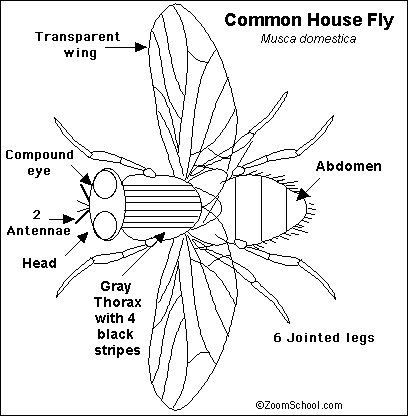
Throughout both the soybean and alfalfa fields I found three different mouthparts. Cutting sponging, piercing sucking, and chewing. The most were chewing, soybeans had two insects and alfalfa had two. I only found one cutting sponging mouth (a fly) in the soybean. I found two insects with piercing sucking mouth one in the soybean and the other in the alfalfa.
Drawing of insect in the alfalfa:

Drawing of insect in the soybean field:

Discussion
The purpose of this lab was to familiarize the students with everyday insects in Kansas’s crops. I personally had a little trouble with this exercise because the mouthparts are so small and hard to actually see what I needed to draw.
I can see that a chewing mouth would be able to do more damage to a plant than another type of mouth.
Limitations of the lab would be microscope quality and insect size. Another limitation that I ran into were having many of the same insect in the bag.
Supplemental Information
Grasshopper Leg


Subscribe to:
Posts (Atom)